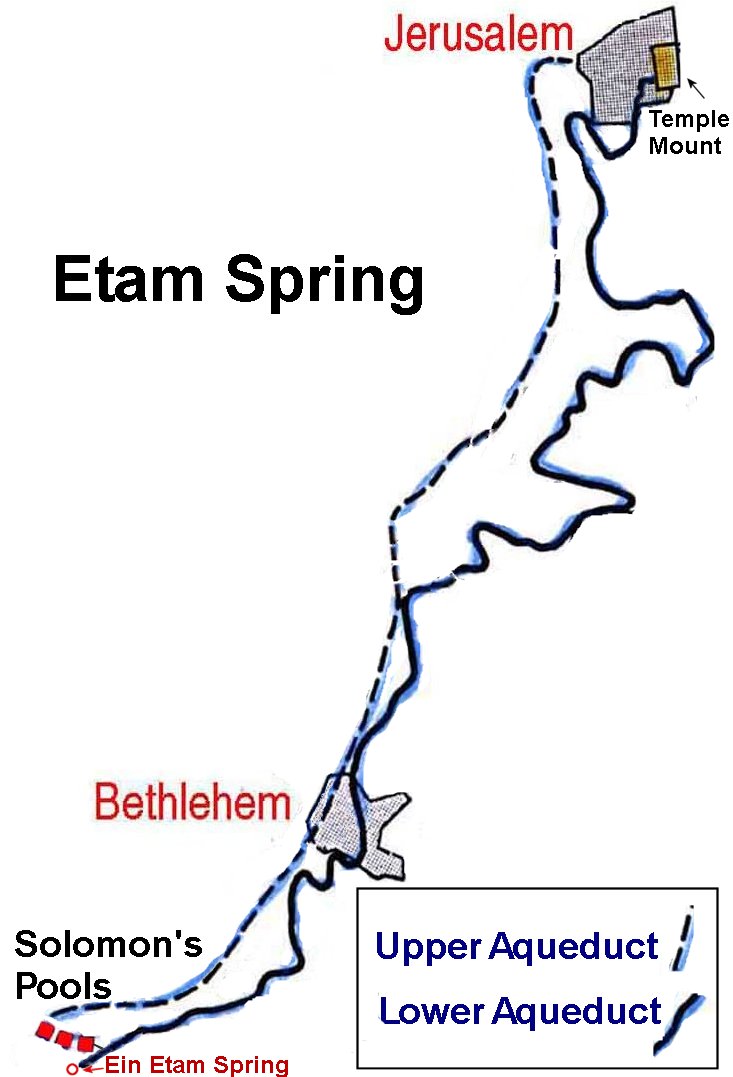
Etam Spring, Ain Atan, Ein Etan. Etam (ā·täm) Spring fed the lower aqueduct coming from a spring of Etam near Bethlehem, and Solomon's Pools located at the head of the Urtas Valley, whence it was conveyed to the Temple Court by a subterranean aqueduct, some 10 miles in length. This has gone into ruin long ago, so that no water from the spring now reaches Jerusalem.
The Lower Aqueduct fed by Etam Spring
According to the Jewish sources Spring Etam was the water source for the Temple, reaching the temple by means of the Lower Aqueduct. This aqueduct brought fresh water to cleanse the temple court of the sacrificial blood each evening, and to fill the laver. It would have been built for this purpose by King Solomon when he built the Temple. Just as it is today when building a house the owner must have a water source before he even considers building, whether it is digging a well or hooking up to a water system. Some claim this lower aqueduct was built by the Hasmonean in the 2nd century BCE, but the Hasmonean would have merely repaired, or improved, an already existing aqueduct. We can conclude that Solomon would not have relied on cisterns to supply the large amount of water needed, on a daily basis to supply the Temple, especially in an arid country that experienced consecutive years of drought.Jewish Sources
The Jerusalem Talmud (Yoma' 31) says that a conduit ran from Atan to the Temple.
Abaye, a Jewish sage of the 4th century was quoted as saying; "If these orifices be now opened, the water rushes in from all sides, and the marble floor of the sanctuary is washed clean of the blood of the sacrifices, if it be ever so much, and thus cleansed of itself, and in the easiest manner. There can be, moreover, never a want of water in these artificially constructed tubes, as it is conducted hither from a large natural spring (Etam), which to a certainty can never dry."
"This is the conclusion of Abaye, a Jewish sage of the 4th century, " What comes out is that the Ein Etam is 23 cubits higher than the Azara (Temple court)."
Tosefta Pesachim, Ch. 3, Par. 12, "How is the Azara cleaned? Seal the area and let the water from the aqueduct enter till it becomes clean like milk."
The lower aqueduct, which led into the outer court of the holy temple, also supplied it with the water necessary for filling the laver. Pesachim, 64a. The Sea of Solomon...of 1 Kings 7:44, also received its water from this aqueduct.
Upper Aqueduct
A second aqueduct, named the Upper Aqueduct, was re-built, or built upon by Pontius Pilate, Herod, and the 10th Legion and was of stone pipes (part of a siphon system). Its destination appears to be 'Hezekiah's Pool' in the Upper City, and did not enter the Temple Mount.
Lower Aqueduct
The Lower Aqueduct bringing water from Etam Spring to the Temple
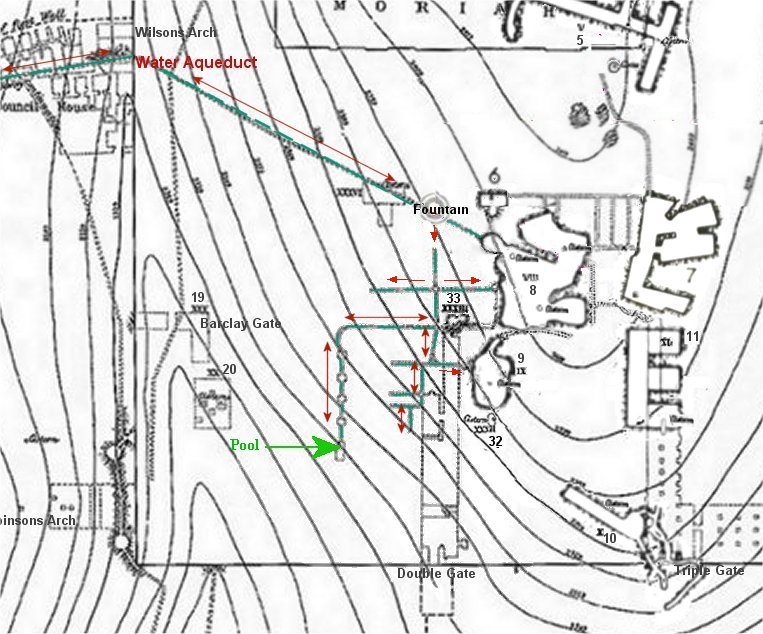
Mount entered the Mount at Wilson's Arch, or bridge,
which traversed the Tyropoen Valley. Within the Mount the aqueduct
flowed toward the southeast and appears to have fed an elaborate
water channel system in the southwestern section on the Temple Mount.
One of these channels had a large man-made cut pool.
The
Brazen Laver
The second reason for fresh water on the Temple Court, or Azara(h); was to fill the brazen laver, which was a very large pot or tub on a pedestal, which held a great amount of fresh water. It had faucets around the sides of it, which could be opened for the cleaning of hands and feet for the purpose of purity. It had to be emptied each night and refilled in the morning with fresh water. During the second temple period a new way of filling the laver was devised called the muchni.
A specially made pool under the Temple court
Ben Katin, one of the High Priests who served during the era of the Second Temple, devised a system for retrieving the water each morning using the mechanism of the muchni, meaning "machinery". The laver was submerged into a specially made pool under the court, and was then hoisted up by the first priest in the morning. The Muchni is also a name for a type of wagon wheel. Wheels installed under the laver may have been needed to roll it from it's place; between the altar and the House of God, over to where the underground pool was located beneath the Azarah, for refilling it. The "hoisting up" of this large pot full of many gallons of water by just one priest would have required an elaborate pulley system. The possible location for the Jewish Temple utilizing this particular water system is noted by, Norma Robertson "Locating Solomon's Temple".
Water channels on the Temple Mount
Once the water entered the Mount, via the aqueduct from Etam Spring, it continued to flow downhill into smaller water channels. These channels were traced by Charles Warren and depicted on one of his maps of the Temple Mount. At the end of one of these smaller channels is a very large underground pool. With Etam Spring aqueduct being the source of water for the temple then the temple would have been located above this subterranean pool. From one of the other smaller channels, on the map, the water would have flowed onto the Priest's court to cleanse it of the blood.